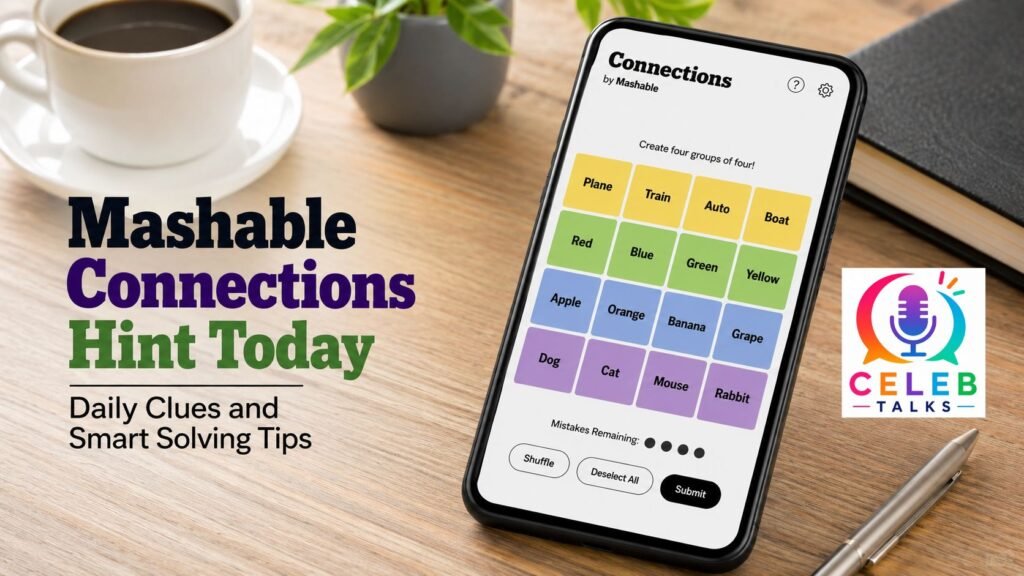

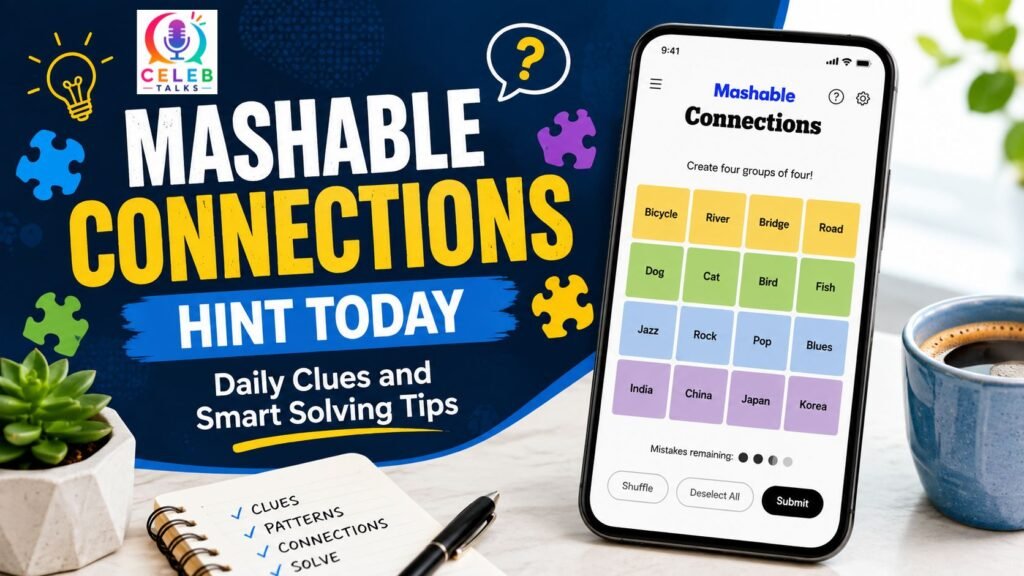
mashable connections hint today If you enjoy word games that test logic, vocabulary, and pattern recognition, Connections can quickly become part of your daily routine. The puzzle looks simple at first: you receive 16 words and must divide them into four related groups of four. However, misleading associations, words with multiple meanings, and carefully placed traps can make the challenge far more difficult than expected. This is why many players search for Mashable Connections hint today when they need a helpful push without immediately revealing the complete answer.
A good hint does more than solve the puzzle for you. It points your thinking in the right direction while preserving the satisfaction of finding the groups yourself. Whether you are protecting a winning streak or simply trying to improve your solving skills, understanding how daily clues work can make every game more enjoyable.
Quick Information
| Detail | Information |
|---|---|
| Puzzle Name | Connections |
| Puzzle Type | Daily word-grouping game |
| Total Words | 16 words |
| Main Objective | Create four related groups |
| Words per Group | Four words |
| Total Categories | Four categories |
| Detail | Information |
|---|---|
| Publisher | The New York Times |
| Puzzle Creator | Wyna Liu |
| Launch Year | 2023 |
| Release Schedule | New puzzle every day |
| Difficulty Colors | Yellow, green, blue, and purple |
| Skills Required | Vocabulary, logic, pattern recognition, and word association |
What Is the Connections Puzzle?
Connections is a daily word-grouping game built around hidden relationships. Each puzzle presents a grid containing 16 words. Your task is to identify four categories and place the correct four words into each one.
The categories may be based on straightforward subjects such as fruits, sports, colors, or clothing. Others can depend on wordplay, phrases, pop culture, spelling patterns, or words that commonly appear before or after another term. Because a single word may appear to fit several possible categories, the game rewards careful comparison rather than quick guessing.
Each completed category is normally represented by a color. Yellow is generally the most direct group, followed by green and blue, while purple often involves the trickiest connection or a playful language pattern. Difficulty can still feel different from one player to another. A movie expert may spot an entertainment category instantly, while someone else may find a vocabulary-based group much easier.
Why Players Search for Mashable Connections Hint Today
Daily hint pages are popular because they offer different levels of help. Some players want only a small clue, while others need the category names or final word groups. Searching for Mashable Connections hint today usually reflects a desire to continue solving without losing the challenge completely.
Hints can be useful when:
- Several words seem to belong to the same broad subject.
- One incorrect word keeps ruining an otherwise promising group.
- A category depends on a reference you do not recognize.
- You have only one mistake remaining and want to avoid a random guess.
- You understand three groups but cannot explain the final connection.
The best way to use a daily clue is gradually. Start with the least revealing hint, return to the grid, and reconsider the words. Only move to a stronger clue if you remain stuck. This approach protects the fun of discovery and helps you become a stronger independent solver over time.
How to Read Daily Connections Clues Without Spoiling the Game
Not every hint reveals the same amount of information. A light clue may describe the general theme of a group, such as “items found in a kitchen.” A stronger clue may give the category itself, while the final level may list every answer.
Before reading a hint page, decide how much assistance you actually want. If you have found no groups, begin with a broad category clue. If you already have three likely words, a category name might be enough to identify the fourth. Avoid jumping straight to the completed answers unless you are ready to end the puzzle.
It also helps to cover or scroll past sections that contain spoilers. Read one clue at a time, then return to the game. Even a short break can make a hidden relationship easier to see.
Smart Solving Tips for Connections
1. Scan All 16 Words Before Making a Move
Your first instinct may be to select four words that look related, but Connections often uses obvious associations as traps. Read the entire grid and note words with clear meanings, unusual spellings, or several possible uses. A full scan helps you see competing categories before spending a mistake.
2. Look for a Highly Specific Group
Broad relationships are risky. Four words may all relate to music, for example, but the intended category could be musical instruments, song titles, famous singers, or words that follow “rock.” Choose a group only when you can describe its connection precisely.
3. Find More Than Four Related Words
If five or six words appear connected, you have probably found an intentional overlap. Do not guess immediately. Ask which four form the narrowest category and where the remaining words might fit. Puzzle designers often include extra words that create a believable but incorrect group.
4. Consider Different Meanings of Common Words
A word such as “bank,” “pitch,” “spring,” or “draft” can have several definitions. If a word seems out of place, stop treating it only by its most familiar meaning. It may refer to a location, action, object, name, or part of a common phrase.
5. Test Words That Appear Before or After Another Word
Many difficult categories are created through compound words and familiar expressions. Four answers might all follow the same word or come before the same ending. Mentally place a shared term beside each candidate and listen for natural phrases.
6. Pay Attention to Word Structure
Sometimes meaning is less important than form. Look for shared prefixes, suffixes, hidden abbreviations, sound patterns, missing letters, or words that change meaning when one letter is added. These patterns are especially useful when the final category seems unrelated on the surface.
7. Use the Shuffle Button
The original arrangement can influence how you see the grid. Shuffling changes the visual order and may separate misleading pairs or place useful candidates near one another. It does not change the solution, but it can interrupt an unproductive train of thought.
8. Solve the Clearest Category First but Verify It
Removing one correct group reduces the number of possible combinations. However, an easy-looking category can still be bait. Before submitting, name the category and check that all four words match it equally well. If one word requires a weak explanation, keep looking.
9. Use Elimination on the Final Eight Words
Once two groups are solved, compare the remaining eight words as two complete sets. Instead of trying to identify only one connection, ask how both groups could work at the same time. A word that fits one category loosely may belong firmly in the other.
10. Pause Before Using Your Last Mistake
When only one attempt remains, avoid emotional guessing. Step away for a minute, shuffle the board, or use one light hint. A short pause often reveals an assumption that has been limiting your search.
Common Mistakes That Make the Puzzle Harder
The most common error is submitting the first four related words you notice. Connections is designed to exploit quick associations, so a plausible group is not always the correct one. Another mistake is relying on a category that is too vague. “Things people use” or “words connected to travel” can include many answers and therefore provide little confidence.
Players also tend to ignore unfamiliar words. An unknown term may be the key to a specific category, so examine how it sounds, whether it could be a name, and what phrases might contain it. Finally, do not assume the hardest group must be solved last. If you recognize a clever language pattern early, submitting it can simplify the entire board.
A Simple Daily Solving Routine
Begin by reading every word once without selecting anything. On the second pass, note possible pairs and strong category candidates. Try to build at least two competing groups before making your first submission. If more than four words overlap, search for the most specific relationship. After every correct group, reassess the remaining board from the beginning instead of forcing your earlier theory.
If you become stuck, shuffle the grid and take a brief pause. Then use a gentle daily clue rather than opening the complete solution. This routine keeps the puzzle entertaining while gradually improving your ability to recognize patterns.
How Hints Can Improve Your Skills
Using hints is not the same as giving up. When used carefully, clues teach you the kinds of relationships that frequently appear in word-grouping puzzles. After finishing, review each category and identify why it was difficult. Did you miss a secondary definition? Were you distracted by an overlapping theme? Did the category depend on a phrase or cultural reference?
This quick review turns one daily puzzle into useful practice. Over time, you will become better at spotting decoys, testing exact category labels, and considering wordplay before making a risky selection.
Mashable Connections Hint Today refers to daily clues designed to help players solve the latest Connections word puzzle. These hints may explain the general themes, provide category clues, or reveal answers for players who are completely stuck.
The puzzle displays 16 words that must be divided into four groups of four. Every group shares a specific connection, such as a common theme, phrase, meaning, cultural reference, or language pattern.
The four categories are normally identified by yellow, green, blue, and purple. Yellow is generally the easiest category, while purple often contains the most difficult connection or complicated wordplay. Green and blue usually represent medium difficulty levels.
Final Thoughts
The popularity of Mashable Connections hint today shows that many players want assistance without losing the pleasure of solving. Daily clues are most valuable when they guide rather than reveal. Start with a broad hint, examine the grid again, and uncover as much of the answer as possible on your own.
Connections becomes easier when you slow down, search for precise groups, consider multiple meanings, and watch for deliberate overlaps. With a thoughtful routine and smart use of hints, you can protect your streak, reduce careless guesses, and enjoy the satisfaction of discovering each hidden connection.