
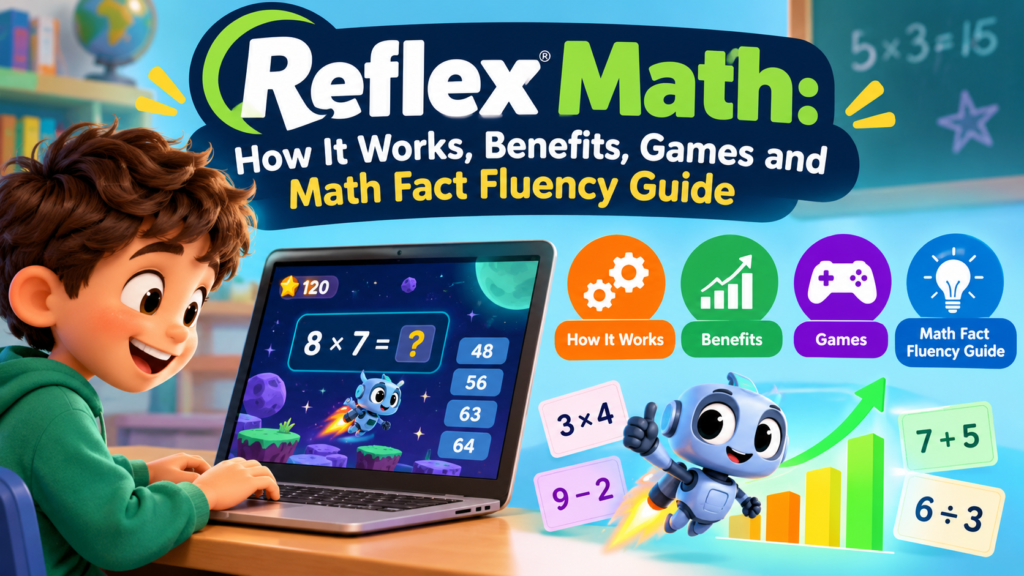

Reflex Math, officially called ExploreLearning Reflex, is an adaptive, game-based learning program designed to help students develop fast and accurate recall of basic addition, subtraction, multiplication and division facts. Instead of functioning as a complete mathematics curriculum, Reflex focuses specifically on math fact fluency and automaticity.
The program adjusts practice to each student’s current level, provides coaching and games, and records progress for teachers and parents. ExploreLearning markets Reflex mainly for students in grade 2 and above, with elementary learners being its core audience.
For students who struggle to remember multiplication tables or repeatedly count basic addition facts, Reflex Math can provide structured practice without relying entirely on traditional worksheets or flashcards.
What Is Reflex Math?
Reflex Math is an online math fact fluency platform developed by ExploreLearning.
Its main purpose is helping students recall basic number facts automatically. A fluent student, for example, should be able to recognize that 8 × 7 = 56 without needing to count, draw a diagram or perform several mental steps.
Reflex covers four fundamental operations:
- Addition
- Subtraction
- Multiplication
- Division
ExploreLearning explains that Reflex identifies the facts a student has not yet mastered and continuously adjusts instruction according to that learner’s performance.
That adaptive approach is one of the major differences between Reflex Math and simply giving every student the same set of multiplication questions.
How Does Reflex Math Work?
A student’s Reflex experience combines assessment, individualized coaching and game-based practice.
When students begin using the platform, Reflex assesses their current math fact knowledge. The system then determines which facts require additional practice.
Students gradually work through appropriate fact families rather than receiving exactly the same questions as everyone else.
Fact Families
Reflex uses related groups of mathematical facts known as fact families.
For example:
- 8 + 3 = 11
- 3 + 8 = 11
- 11 − 8 = 3
- 11 − 3 = 8
Teaching related facts together can help students recognize the relationship between addition and subtraction.
A similar approach applies to multiplication and division.
For instance:
- 6 × 7 = 42
- 7 × 6 = 42
- 42 ÷ 6 = 7
- 42 ÷ 7 = 6
ExploreLearning says this fact-family structure is an important part of how Reflex develops automatic recall.
What Is Math Fact Fluency?
Math fact fluency means being able to recall basic mathematical facts accurately, quickly and with little conscious effort.
Suppose a student is solving:
56 ÷ 8
A fluent student can immediately answer 7.
Another student might eventually reach the same answer but need to count, repeatedly subtract or mentally reconstruct the multiplication table.
Both may understand division, but only the first student has automatic recall of that particular fact.
This matters because students have limited working-memory capacity. When basic calculations require less mental effort, more attention can be devoted to fractions, algebra, word problems, reasoning and other complex tasks.
What Is the Reflex Math Green Light?
The Green Light is one of the most important features in ReflexMath.
Students work toward earning a Green Light each day they use the program. It appears after the student has correctly answered the required amount of math facts for meaningful daily practice.
Importantly, the Green Light is based on correct answers rather than simply spending a certain amount of time online.
ExploreLearning says many students can reach it after around 15–20 minutes of concentrated practice. The company recommends earning a Green Light at least three days each week, while shorter and more frequent sessions are generally preferred to occasional long sessions.
This gives teachers a simple way to judge whether students have completed enough meaningful practice for the day.
Reflex Math Games and Rewards
A major reason Reflex differs from traditional math drills is its use of games.
Students practice math facts while participating in activities on Reflex Island. They initially receive access to selected games and can unlock more as they continue earning Green Lights.
Official ExploreLearning materials list games such as:
- Ninja to the Stars
- Wind Rider
- Alien Sundae
- Blok Bot
- Egyptian Conniption
- Fizz Heads
- Kirie
- QuickSlither
- Swamp Chomper
Students can also earn tokens and use them to customize avatars and other items inside the platform.
The rewards do not replace the learning activity. Math fact responses remain integrated into the games so that students continue practicing while progressing.
Why Reflex Math Can Be Useful
1. Personalized Practice
Students in the same classroom rarely struggle with exactly the same facts.
One learner may instantly recall addition facts but struggle with subtraction. Another may know most multiplication facts except combinations involving seven, eight or nine.
Reflex adjusts practice based on individual performance rather than assigning identical drills to every learner.
2. Game-Based Motivation
Repeated math fact practice can become monotonous.
Games, unlockable content, tokens and progress indicators give students additional reasons to continue practicing.
For children who dislike worksheets, this can make repeated exposure to math facts more appealing.
3. Progress Tracking
Reflex includes reporting tools for educators.
Available reports can show information such as:
- Percentage of facts fluent
- Recent fluency growth
- Usage frequency
- Green Light completion
- Facts solved
- Recent login activity
Teachers can view both individual and class-level information.
This can help teachers identify students who are progressing steadily and those who may need additional support.
4. Short Practice Sessions
Students do not necessarily need to spend an hour using Reflex.
ExploreLearning recommends regular, shorter practice and generally suggests students earn the Green Light at least three days each week.
That makes Reflex easier to include in math centers, intervention periods, homework routines or independent practice.
What Reflex Math Does Not Replace
Reflex Math should not be confused with a complete mathematics curriculum.
Its main strength is fact fluency.
Students still need instruction in areas such as:
- Number sense
- Mathematical reasoning
- Fractions
- Geometry
- Measurement
- Problem-solving
- Mathematical vocabulary
- Algebraic thinking
- Conceptual understanding
A child who can answer 7 × 8 instantly still needs to understand what multiplication represents and how to apply multiplication in unfamiliar situations.
ExploreLearning itself recommends that students develop conceptual understanding of an operation before using Reflex to build automaticity with those facts.
For this reason, Reflex generally works best as a supplement to good mathematics instruction, rather than as a replacement for it.
Who Is Reflex Math For?
Reflex is primarily designed for school-age learners building fluency with basic arithmetic.
ExploreLearning currently markets Reflex for grades 2+, while its trial information identifies grades 2–6 as its core range and notes that older learners may also benefit from intervention or remediation.
It may be particularly useful for students who:
- Understand mathematical concepts but calculate basic facts slowly
- Frequently count on their fingers
- Need additional multiplication-table practice
- Lack confidence with basic arithmetic
- Need structured intervention
- Benefit from game-based learning
Teachers should still consider each student’s readiness rather than assigning Reflex purely according to age.
Reflex Math Login: How Students Access It
The exact Reflex Math login process can vary depending on the school.
Some students receive Reflex usernames and passwords from their teachers. Schools using single sign-on or automatic rostering may instead require students to enter Reflex through the school’s normal learning portal or launchpad.
ExploreLearning advises students in SSO-enabled districts to use their school’s designated portal because their accounts are linked through that system.
Therefore, if a student cannot access Reflex, the best first step is usually to check the login information supplied by the teacher or school rather than creating a separate account.
Can Parents Use Reflex Math at Home?
Students who already receive Reflex through their school may often be able to continue their assigned practice outside school using their existing access.
Parents can also receive reporting invitations in supported Reflex setups to monitor a child’s progress.
For families independently looking for a home or homeschool version, ExploreLearning directs parents and tutors to Time4MathFacts, which uses the same underlying Reflex-style games and approach but is packaged for home users.
Is Reflex Math Free?
Reflex Math is not generally a permanently free platform.
ExploreLearning offers paid teacher and school licenses, with pricing varying according to subscription type and number of students. Instead of displaying one universal school price, the company provides customized quotes.
At the time of writing, ExploreLearning also advertises a 30-day free Reflex trial for educators.
Schools should check the official Reflex website for current licensing terms because pricing and promotions can change.
Does Reflex Math Actually Help Students?
There is a reasonable instructional argument behind math fact fluency: automatic recall reduces the amount of mental effort spent on simple calculations, leaving students with more capacity for complex mathematical reasoning.
ExploreLearning also publishes research reporting positive associations between regular Reflex use, greater fact fluency and mathematics achievement.
One recent company-reported analysis involving more than 35,000 students in grades 3–5 found substantially greater fluency growth in schools categorized as frequent Reflex users. ExploreLearning also reports that students meeting its recommended usage levels have shown stronger outcomes in other studies.
These findings are encouraging, but readers should distinguish between evidence showing positive results and the stronger claim that one program will produce identical results for every child.
Student progress can also depend on teaching quality, prior knowledge, frequency of use, motivation and additional learning support.
How to Get Better Results From Reflex Math
Simply logging into Reflex occasionally is unlikely to produce the best outcome.
A stronger routine is to:
- Make sure the student understands the mathematical operation conceptually.
- Use Reflex consistently rather than relying on occasional long sessions.
- Aim for the Green Light during practice days.
- Monitor fluency reports instead of focusing only on time spent playing.
- Celebrate genuine progress without turning every session into a competition.
- Continue teaching problem-solving and mathematical concepts outside Reflex.
ExploreLearning recommends reaching the Green Light at least three days each week and notes that shorter, frequent practice is more effective than infrequent extended sessions.
Reflex Math: Advantages and Limitations
Advantages
Reflex offers adaptive practice, game-based motivation, individualized instruction and detailed progress reporting. It can make repetitive math fact practice more engaging and gives educators useful information about student fluency.
Limitations
Reflex concentrates on a specific skill rather than the entire mathematics curriculum. It also requires digital access and normally requires a school, teacher or home subscription.
Students should therefore use it alongside broader instruction that develops reasoning, conceptual knowledge and problem-solving.
FAQs About Reflex Math
What is Reflex Math used for?
Reflex Math is used to help students develop automatic recall of addition, subtraction, multiplication and division facts through adaptive instruction, coaching and educational games.
What grade is Reflex Math for?
ExploreLearning markets Reflex for grade 2 and above, with grades 2–6 forming its main elementary audience. It can also be used for intervention with older students who still need basic math fact fluency support.
How long should students use Reflex Math?
Rather than requiring a fixed session length, Reflex uses its Green Light system. ExploreLearning says many students reach the Green Light after approximately 15–20 minutes of concentrated practice and recommends achieving it at least three days per week.
Is Reflex Math only multiplication?
No. Reflex supports addition, subtraction, multiplication and division fact fluency.
Is Reflex Math free?
Reflex is primarily a paid subscription product. ExploreLearning currently advertises a 30-day educator trial, while ongoing licensing depends on the type of account and number of students.
Can students use Reflex Math at home?
Students with school-provided access may be able to practice outside school using their existing credentials. ExploreLearning also offers a related home-user option through Time4MathFacts.
Is Reflex Math a complete curriculum?
No. Reflex specializes in basic math fact fluency. Students still need broader mathematics instruction covering concepts, reasoning, problem-solving and other curriculum topics.
Conclusion
Reflex Math is best understood as a focused tool for building math fact fluency rather than a complete math-learning program.
Its adaptive system identifies the facts individual students need to practice, while games, rewards, coaching and the Green Light system encourage consistent participation. Teachers can then use detailed reports to monitor both usage and fluency growth.
For students who already understand addition, subtraction, multiplication or division but still struggle to recall basic facts quickly, Reflex can provide useful structured practice. The strongest approach is to combine that practice with high-quality classroom teaching, mathematical reasoning and real-world problem-solving.