
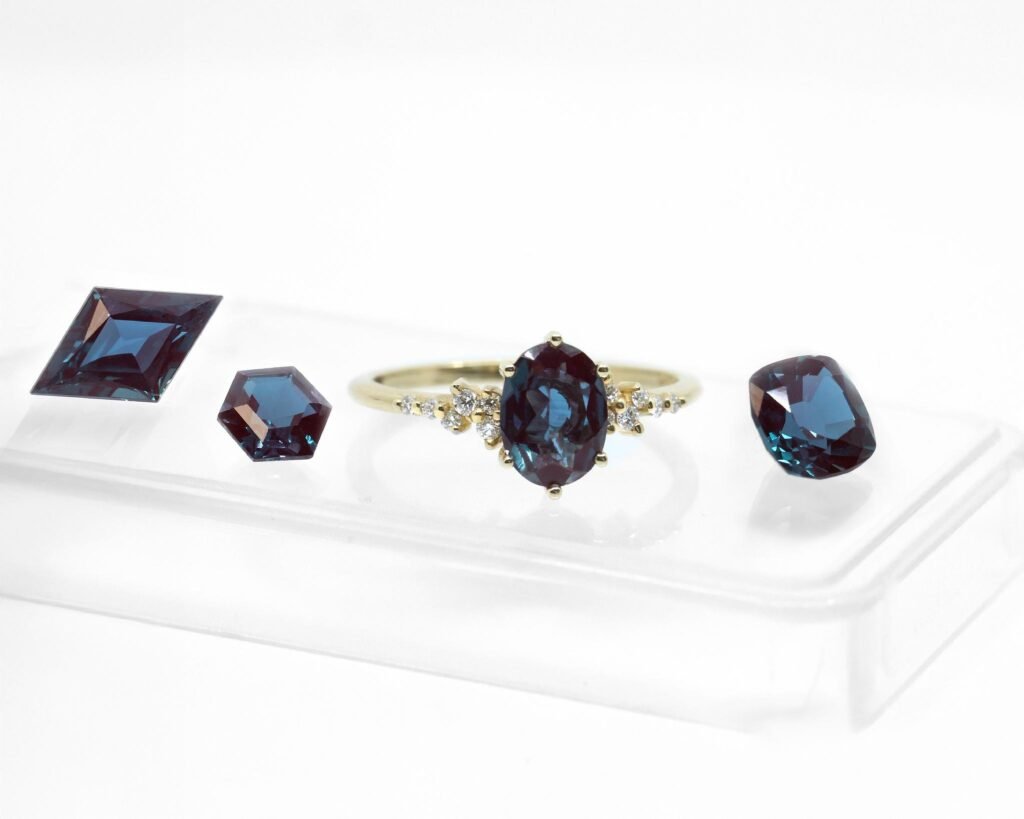

Classic solitaires are still widely chosen, but women are increasingly personalizing them through oval and elongated stones, yellow gold, bezel and east-west settings, vintage-inspired details, colored gemstones, and custom design.
Current U.S. wedding data shows just how broad preferences have become: round and oval stones are almost equally popular, yellow gold has continued to gain ground, lab-grown diamonds now represent a majority of engagement-ring center stones, and most couples make some form of customization.
So what are the engagement ring styles women are choosing right now?
1. Solitaire Rings Are Still the Starting Point
The solitaire hasn’t disappeared.
Far from it.
A single center gemstone remains one of the most recognizable engagement ring designs because it puts nearly all the attention on the stone.
According to The Knot’s 2026 Real Weddings Study, 38% of engagement rings use a solitaire setting, making it a major part of the current market.
What has changed is what a solitaire can look like.
Instead of automatically meaning a round diamond on a thin white-gold band, today’s solitaire might feature an oval lab-grown diamond, a marquise sapphire, a chunky yellow-gold band, an east-west emerald cut, or a bezel-set colored gemstone.
The structure remains simple.
The details make it personal.
2. Round and Oval Stones Are Nearly Neck and Neck
If there is one shape story that defines the current market, it is the competition between round and oval stones.
The Knot’s latest 2026 U.S. data puts round stones at 26% of engagement rings and oval stones at 25%.
That makes them effectively the two dominant shapes.
Round brilliant diamonds remain familiar for their symmetry and sparkle, while ovals offer a softer elongated silhouette.
An oval can also appear visually larger across the finger than a round stone of similar carat weight because of its elongated proportions.
Oval rings can be traditional or contemporary depending on the setting. A four-prong oval solitaire feels different from an east-west bezel-set oval, even though the center-stone shape is identical.
3. Marquise Cuts Are Making a Comeback
Another elongated shape receiving renewed attention is the marquise.
The marquise has a long center with pointed ends, creating a distinctive silhouette and substantial coverage across the finger.
Current U.S. data puts marquise at around 8% of engagement-ring shapes, alongside emerald, princess, and pear shapes.
Its return also reflects a broader shift toward shapes with more character.
Instead of choosing a gemstone purely because it is universally familiar, couples are increasingly asking what looks distinctive on the hand.
Marquise stones can work as minimal solitaires, in bezel settings, or as part of more elaborate nature-inspired and vintage compositions.
4. Yellow Gold Is Back in a Major Way
For years, white gold and platinum dominated contemporary bridal jewelry.
That balance has changed.
The Knot’s 2026 research shows yellow gold at 39% of engagement rings, with its popularity having increased substantially over the previous five years.
Yellow gold introduces warmth and creates stronger contrast with colorless diamonds.
It can also complement colored gemstones particularly well, including green, teal, champagne, peach, and earthy tones.
This shift is influencing ring design itself.
Rather than trying to make the setting disappear around a white diamond, designers can intentionally make the gold part of the visual composition.
5. Bezel Settings Are Becoming More Visible
Prongs remain fundamental to engagement-ring design, but bezel settings are increasingly appearing in contemporary rings.
A bezel surrounds all or part of a gemstone with a rim of precious metal.
The result is usually cleaner and more architectural than a traditional prong setting.
It also provides additional protection around the stone’s perimeter, which can make bezels appealing to people with active lifestyles.
In 2026, the bezel is also being used creatively.
Think east-west ovals, emerald cuts surrounded by yellow gold, chunky bands, or colored gemstones framed in contrasting metal.
The setting itself becomes part of the design rather than simply the mechanism holding the gemstone.
6. East-West Settings Turn Familiar Stones Sideways
One of the simplest ways to make a familiar gemstone look different is to rotate it.
An east-west setting positions an elongated stone horizontally across the finger instead of vertically.
Oval, emerald, marquise, and elongated cushion stones can all be set this way.
The idea isn’t new, but it fits particularly well with the current preference for rings that feel personal without becoming overly complicated.
A traditional emerald-cut diamond, for example, can suddenly feel much more contemporary when positioned horizontally in a bezel setting.
7. Vintage and Antique-Inspired Rings Are Growing
Another important 2026 direction is a return to jewelry with visible historical influence.
Old mine cuts, Old European cuts, antique cushion shapes, milgrain, engraving, geometric details, and substantial gold settings are appearing alongside modern bridal designs.
Rather than reproducing an antique ring exactly, many contemporary designs borrow selected elements from historical jewelry.
That can mean combining an antique-style diamond cut with a modern bezel or using Art Deco-inspired geometry in a newly made ring.
Vogue’s current overview of 2026 engagement ring trends similarly identifies antique-cut diamonds, bezel settings, east-west orientations, substantial gold bands, colored stones, and greater individuality as important directions in bridal jewelry this year.
8. Colored Gemstones Are Moving Further Into Bridal Jewelry
A white diamond is still the dominant engagement-ring center stone, but it is no longer the only obvious choice.
Sapphires and moissanite currently lead the non-diamond category in U.S. engagement-ring data.
Beyond them, couples are exploring emeralds, tourmalines, moss agate, alexandrite, champagne diamonds, salt-and-pepper diamonds, and other gemstones.
Color changes the design immediately.
A teal sapphire in yellow gold feels very different from a colorless diamond in platinum, even if both use exactly the same setting.
This makes gemstone choice one of the easiest ways to personalize a ring without requiring an elaborate design.
9. Lab-Grown Diamonds Have Become Mainstream
One of the largest changes in engagement-ring buying isn’t a setting or gemstone shape.
It is diamond origin.
The Knot’s 2026 Real Weddings Study reports that 61% of engagement-ring purchases now feature a lab-grown center stone.
That represents a major shift from only a few years ago.
One practical consequence is that couples can often choose larger diamonds while staying within a particular budget.
The study reports an average center-stone size of around 2.0 carats for lab-grown stones compared with 1.6 carats for natural stones.
This has also influenced design trends because larger center stones can change the proportions that work well for settings, bands, and accent stones.
10. Hidden Halos Offer Detail Without a Traditional Halo
The classic halo surrounds the center gemstone when viewed from above.
A hidden halo takes a subtler approach.
Small diamonds are positioned around the base of the center setting, meaning much of the additional sparkle becomes visible from the side rather than dominating the top view.
This works well for someone who likes the simplicity of a solitaire but wants more detail.
It is another example of a broader current trend: personalization doesn’t necessarily mean making a ring more elaborate from every angle.
Sometimes the interesting detail is deliberately hidden.
11. Colored and Warm-Toned Diamonds Are Emerging
Not every diamond needs to be perfectly colorless.
Champagne, yellow, brown, gray, and other warm-toned diamonds are receiving increased attention in contemporary bridal jewelry.
These stones work particularly well with yellow gold and vintage-inspired settings.
Their appeal also connects with the broader movement toward gemstones with visible individuality.
Instead of every stone being selected to approach the same visual ideal, differences in color can become part of the design.
12. Customization May Be the Biggest Trend of All
Perhaps the most important engagement-ring trend in 2026 isn’t a particular gemstone or setting.
It is personalization.
The Knot’s latest research reports that 88% of couples made custom edits or custom-designed their ring.
That is a significant number.
It suggests that buyers increasingly see an engagement ring as something that can be adjusted around the person wearing it rather than simply selected from a fixed set of options.
Customization might mean changing the center gemstone, choosing another metal, modifying accent stones, adjusting proportions, or creating an entirely new design.
When browsing engagement rings for women, it therefore makes sense to look beyond individual products and consider which elements could reflect the wearer’s own style.
What Are the Most Popular Engagement Ring Choices in 2026?
For a quick answer, the current market can be summarized like this:
Setting: Solitaire remains highly popular.
Shapes: Round and oval dominate, while marquise, emerald, pear, and princess cuts provide alternatives.
Metal: Yellow gold continues to rise.
Center stone: Clear diamonds remain dominant, but colored gemstones have a growing role.
Diamond origin: Lab-grown diamonds now represent the majority of center-stone purchases in current U.S. data.
Design direction: Bezel settings, east-west stones, vintage influences, warmer colors, and substantial gold bands are increasingly visible.
Personalization: Customization has become mainstream rather than unusual.
Should You Follow Engagement Ring Trends?
Trends are useful for discovering possibilities.
They shouldn’t make the final decision.
An engagement ring is likely to be worn much longer than any particular jewelry trend lasts.
Someone who genuinely prefers a round solitaire shouldn’t choose an east-west marquise simply because it is fashionable in 2026.
Likewise, someone who has always loved colored gemstones shouldn’t feel obligated to choose a colorless diamond because it remains the most common option.
Use trends as inspiration rather than instructions.
How Should You Choose Between Current Styles?
Start with the wearer.
Look at the jewelry she already chooses.
Does she wear yellow or white metals?
Does she prefer minimal jewelry or decorative pieces?
Does she like color?
Does her wardrobe lean modern, vintage, romantic, geometric, or organic?
Then consider lifestyle.
Someone who works frequently with their hands may appreciate a lower-profile or protective setting. Someone who loves intricate jewelry may prefer clusters, side stones, or vintage-inspired details.
Finally, think about the wedding band.
Some engagement-ring settings pair easily with straight bands, while others may require a curved or custom-fitted wedding ring.
The most successful choice is where appearance and everyday practicality meet.
Frequently Asked Questions
What is the most popular engagement ring shape in 2026?
Current U.S. data places round stones first at approximately 26%, closely followed by oval stones at 25%.
Are oval engagement rings still popular?
Yes. Ovals remain one of the two most popular engagement-ring shapes and continue to work across solitaire, bezel, halo, and three-stone designs.
What engagement ring metal is popular right now?
Yellow gold is particularly strong in 2026. Current U.S. data reports it in approximately 39% of engagement rings.
Are lab-grown diamonds still trending?
Yes. They have moved beyond being a niche trend. Current 2026 data reports lab-grown stones in 61% of engagement-ring purchases.
What non-traditional engagement rings are popular?
Colored gemstones, antique-inspired rings, east-west settings, bezels, marquise cuts, warm-toned diamonds, and custom designs are all receiving increased attention.
Are women still choosing solitaire engagement rings?
Yes. Solitaire settings remain one of the dominant choices, accounting for approximately 38% of rings in current U.S. data. What is changing is how the solitaire is interpreted through different shapes, metals, settings, and gemstones.
Final Thoughts
The clearest engagement-ring trend in 2026 isn’t that one style has replaced another.
It is that women have more accepted choices than ever before.
Round diamonds and classic solitaires remain strong. Oval stones are nearly as popular as rounds. Yellow gold has returned prominently, while bezel and east-west settings offer cleaner contemporary alternatives. Vintage influences are bringing antique cuts and decorative details back into focus, and colored gemstones provide an alternative to the traditional colorless diamond.
At the same time, lab-grown diamonds have fundamentally changed what buyers can choose within different budgets.
But perhaps the most revealing statistic is that 88% of couples now make some type of custom edit or create a custom design.
The direction of engagement rings in 2026 is therefore less about everyone choosing the same fashionable ring.
It is about taking the styles, stones, and settings available and turning them into something personal.