
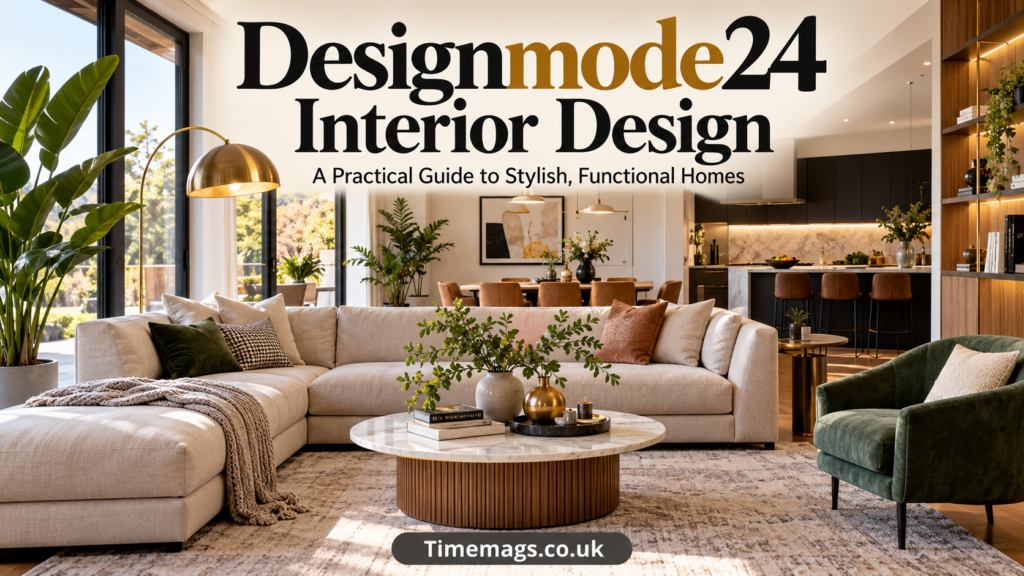

If you are searching for Designmode24 interior design, the simplest explanation is this: it is a practical approach to creating attractive, comfortable, and functional living spaces rather than a formally established historical design movement such as Art Deco, Bauhaus, or Mid-Century Modern.
The Designmode24 name currently appears across several home-design websites and resources, so descriptions are not always identical. The main Designmode24.de website presents itself as a resource for making homes more practical and enjoyable, covering interior inspiration, everyday home advice, kitchens, and related topics.
For homeowners, however, the most useful interpretation is straightforward: start with how a room needs to work, then use color, furniture, lighting, materials, storage, and decoration to make it beautiful.
What Is Designmode24 Interior Design?
Designmode24 interior design can be understood as a function-first method of decorating and improving a home.
Rather than following one rigid visual formula, the approach brings together several important elements:
- Practical room layouts
- Comfortable furniture
- Coordinated color palettes
- Layered lighting
- Useful storage
- Personal decoration
- Appropriate materials and textures
- A balance between current trends and long-term usability
Designmode24’s own home content emphasizes spaces that work for real everyday life rather than focusing entirely on appearance. Its material discusses interiors as a combination of aesthetics, personality, comfort, and function.
That flexibility is one reason the concept can work with modern, minimalist, Scandinavian-inspired, rustic, contemporary, or more traditional interiors.
Is Designmode24 an Official Interior Design Style?
Not in the same sense as recognized historical styles such as Victorian, Bauhaus, Art Deco, or Mid-Century Modern.
This distinction is important because online searches currently return multiple similarly named Designmode24 websites. Some describe themselves primarily as interior-design and home-improvement resources, while others use the name more broadly for home inspiration.
For example, www. designmode24. com describes its purpose as providing practical home-improvement guides, room-design ideas, furniture layouts, storage solutions, décor inspiration, DIY advice, and renovation guidance.
Therefore, it is more accurate to think of Designmode24 interior design as a practical design philosophy or online home-design concept, not as a movement with a fixed set of historical rules.
Core Principles of Designmode24 Interior Design
1. Function Comes Before Decoration
A beautiful room can still be frustrating if you constantly walk around oversized furniture, have nowhere to store everyday items, or cannot comfortably use the space.
Begin by asking:
- What activities happen here?
- How many people regularly use the room?
- Where should people walk?
- What needs to be stored?
- Where is additional lighting required?
Answer those questions before choosing decorative accessories.
A functional layout creates the foundation. Decoration can then enhance it.
2. Create a Clear Focal Point
Most successful rooms benefit from a visual anchor.
Depending on the room, that could be:
- A fireplace
- A large window
- An artwork
- A bed
- A dining table
- A feature wall
- A statement light fixture
Avoid making every object compete for attention. One dominant feature supported by quieter surrounding elements usually creates a calmer, more deliberate interior.
3. Use a Controlled Color Palette
You do not need dozens of colors to make a room interesting.
A practical approach is to select:
A base color: used on larger surfaces such as walls or major furniture.
A supporting color: introduced through curtains, chairs, rugs, or cabinetry.
An accent: used sparingly in cushions, artwork, accessories, lamps, or decorative objects.
Neutral shades such as warm white, beige, taupe, soft grey, and earthy tones can create a flexible foundation, while stronger accents introduce personality.
The goal is coordination rather than making everything identical.
Designmode24 Interior Design and Lighting
www. designmode24. com Lighting is one of the easiest ways to change how a room feels without replacing all its furniture.
Instead of depending on one central ceiling light, consider multiple lighting layers.
Ambient Lighting
This provides general illumination through ceiling fixtures, recessed lighting, or larger lamps.
Task Lighting
Task lighting supports specific activities.
Examples include:
- Kitchen counter lights
- Desk lamps
- Reading lamps
- Bathroom mirror lights
- Bedside lamps
Accent Lighting
Accent lighting draws attention to architectural details, artwork, shelving, plants, or textured walls.
Combining these layers gives you more control over both atmosphere and practical visibility.
Natural daylight should also influence your choices. Before choosing paint or placing furniture, observe how sunlight enters a room during different parts of the day.
Furniture: Choose Scale Before Style
One of the most common decorating problems is purchasing furniture because it looks attractive individually rather than considering how it fits the room.
Before buying a sofa, dining table, bed, storage unit, or armchair, measure:
- Floor dimensions
- Doorways
- Windows
- Existing furniture
- Walking paths
- Clearance around doors and drawers
Large furniture can overwhelm a small interior, while furniture that is too small may make a spacious room feel disconnected.
Designmode24‘s broader approach emphasizes practical layouts and usable living spaces, making furniture scale an important consideration.
Add Texture to Make Rooms Feel Complete
A room can have beautiful colors and still feel flat.
Texture creates depth.
Consider combining materials such as:
- Linen
- Cotton
- Wool
- Wood
- Stone
- Glass
- Ceramic
- Metal
- Woven fibers
For example, a neutral living room could combine a fabric sofa, timber coffee table, woven rug, ceramic accessories, soft curtains, and a metal lamp.
The colors may remain restrained, but the different surfaces prevent the space from looking monotonous.
Designmode24 Interior Ideas for Different Rooms
Living Room
A good living room should support conversation, relaxation, and everyday activities.
Start with the largest pieces and establish an obvious circulation path. Position seating in a way that encourages interaction instead of automatically pushing everything against the walls.
Then introduce personality through artwork, plants, books, cushions, throws, and meaningful objects.
Keep decorative additions selective. Empty space is also part of a design.
Bedroom
Comfort should dominate bedroom planning.
Prioritize:
- A comfortable bed
- Accessible bedside surfaces
- Warm or adjustable lighting
- Practical clothing storage
- Window coverings appropriate for sleep
- Calm colors and textures
A bedroom does not need excessive decoration. A visually quieter environment often produces a more restful atmosphere.
Kitchen
Kitchen design should begin with workflow rather than accessories.
Consider where you:
- Store ingredients
- Prepare food
- Cook
- Serve meals
- Wash dishes
- Store everyday equipment
Items used frequently should generally be easier to reach than occasional appliances or serving pieces.
The main Designmode24.de website includes dedicated kitchen-related content alongside general home advice, reinforcing the broader emphasis on practical everyday spaces.
Bathroom
Bathrooms require an especially careful balance between appearance and durability.
Priorities include:
- Appropriate ventilation
- Water-resistant surfaces
- Useful storage
- Effective mirror lighting
- Easy-to-clean finishes
- Sufficient room for movement
Small bathrooms can benefit from wall-mounted storage, large mirrors, simple palettes, and keeping unnecessary objects off countertops.
Home Office
A productive workspace should support concentration before it becomes decorative.
Focus on:
- Suitable desk height
- A supportive chair
- Task lighting
- Accessible power
- Cable organization
- Storage
- Reduced visual clutter
After solving these essentials, add artwork, plants, personal objects, or color.
Small Spaces and Designmode24 Interior Design
Small homes benefit particularly well from a function-first approach.
Consider furniture that performs more than one job, such as:
- Storage ottomans
- Beds with drawers
- Extendable dining tables
- Nesting tables
- Storage benches
- Wall-mounted desks
- Shelving that uses vertical space
Another useful principle is visual continuity. Repeating related colors and materials between connected rooms can make a compact home feel calmer and more cohesive.
Avoid assuming that every small room must contain only tiny furniture. Sometimes one appropriately proportioned statement piece works better than several small objects that create visual clutter.
How to Start a Designmode24-Inspired Makeover
You do not need to renovate the entire house at once.
Start with one room.
Step 1: Identify the Problem
Do you lack storage?
Is the room dark?
Does furniture block movement?
Does the space feel unfinished?
Knowing the real problem prevents unnecessary purchases.
Step 2: Measure Everything
Create a simple floor plan and record major dimensions.
Step 3: Decide What Stays
Keeping useful furniture saves money and gives the new design a starting point.
Step 4: Choose Your Palette
Select a controlled collection of complementary colors and materials.
Step 5: Fix the Layout
Arrange major furniture before spending heavily on decoration.
Step 6: Improve Lighting
Introduce appropriate ambient and task lighting.
Step 7: Add Decoration Last
Finish with art, textiles, plants, books, mirrors, or meaningful personal items.
Following this order reduces impulse purchases and makes the finished interior feel intentional.
Common Interior Design Mistakes to Avoid
Even an expensive room can feel unsuccessful when basic planning is overlooked.
Watch for these common problems:
- Buying furniture without measuring
- Depending entirely on overhead lighting
- Following trends that do not suit your lifestyle
- Filling every empty surface
- Using too many unrelated colors
- Ignoring storage until the end
- Choosing appearance over comfort
- Hanging curtains or artwork without considering proportion
- Buying every item from one matching furniture collection
The strongest interiors usually look collected rather than copied directly from a showroom.
Does Designmode24 Work on a Budget?
Yes. Function-first design does not require replacing everything you own.
Low-cost improvements can include rearranging furniture, removing clutter, repainting walls, changing lampshades, introducing warmer bulbs, updating cabinet hardware, adding second-hand furniture, moving artwork, changing cushion covers, or adding plants.
Spend more where longevity and daily comfort matter for example, a frequently used sofa, mattress, desk chair, durable flooring, or quality storage.
Save on accessories that can easily be changed later.
The Future of Practical Interior Design
The strongest direction in contemporary home design is not simply about following the newest visual trend. People increasingly expect their homes to perform several roles: living area, workplace, entertainment space, storage environment, and place to relax.
That makes adaptable planning especially valuable.
Designmode24’s current home-design positioning similarly focuses on practical interiors that support everyday living rather than simply creating picture-perfect rooms.
A home therefore does not need to match a single named style to feel well designed. It needs coherence, usefulness, comfort, and enough personality to feel like your own.
Conclusion
Designmode24 design is best understood as a practical, flexible approach to creating homes that look attractive while supporting everyday life. It is not a formally defined historical interior-design movement with one mandatory color scheme or furniture style.
Its useful principles are simple: understand how a room will be used, solve the layout first, choose appropriately scaled furniture, create effective lighting, establish a coordinated palette, provide sufficient storage, and add personality through materials and decoration.
Most importantly, do not design your home only for photographs or trends. Design it around the people who actually live there. When function, comfort, and style support one another, even modest changes can make a room feel considerably more intentional.