
Imagine buying an engagement ring and not having to choose between blue, green, pink, or peach — because the same gemstone can come in all those colors.
That gemstone is tourmaline, which comes in an extraordinary array of colors: green, pink, red, blue, teal, yellow, orange, purple, brown, black, or colorless. And, in some cases, you can get two or more colors in a single stone.
Tourmaline’s remarkable color versatility is one reason it is an appealing alternative gemstone for engagement rings and wedding bands — the color of the center stone can be selected and specified to an unusual degree.
Of course, for many buyers, color is not the only consideration. Tourmaline is a 7 to 7.5 on the Mohs scale, which means it is not as hard as Sapphire or Diamond. Choosing tourmaline as the gem of engagement rings requires a balance between color, uniqueness, and design appeal and practicality and wear.
What Is a Tourmaline?
Tourmaline is not one single mineral with one particular chemistry.
It is a group of related minerals that share similar traits but can have markedly different colors due to variations in their chemistry. In fact, variations in tourmaline chemistry are so great they result in one of the broadest color ranges of any gemstone.
Two tourmalines can look nothing alike and still be the same gem species, or two tourmalines that seem very different can actually be the same mineral.
What Colors Does Tourmaline Come In?
You can find tourmaline in nearly every color of the rainbow.
Among the most common are:
- Green Tourmaline
- Pink Tourmaline
- Red Tourmaline
- Blue Tourmaline
- Teal Tourmaline
- Yellow Tourmaline
- Orange Tourmaline
- Peach Tourmaline
- Purple Tourmaline
- Brown Tourmaline
- Black Tourmaline
- Colorless Tourmaline
And, in some cases, multiple colors in one stone.
The Gemological Institute of America has a helpful summary of the various tourmaline colors, types, and quality considerations in its GIA guide to tourmaline.
The color range is part of tourmaline’s appeal, particularly for jewelry such as engagement rings because, with tourmaline, you aren’t limited to just one hue.
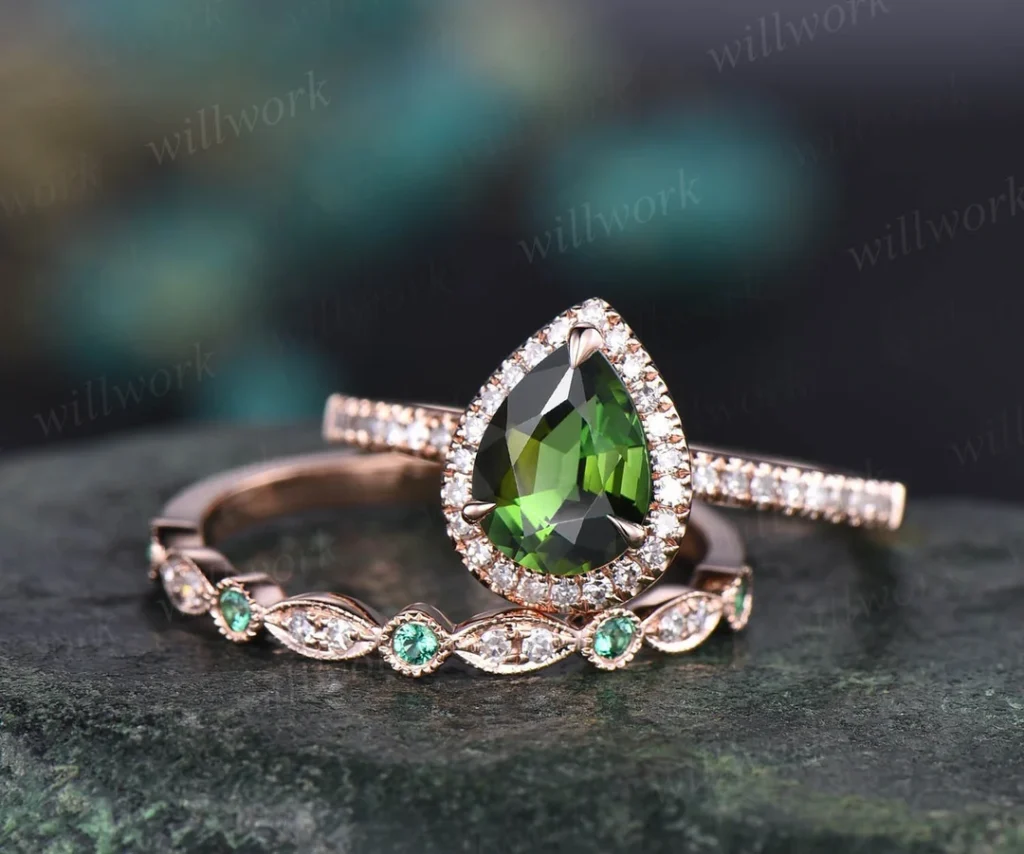
Green Tourmaline
Green is one of the most common — and most appealing — tourmaline colors.
But what makes green tourmaline special is that there is a huge range of green coloration in tourmaline gems.
The mineral can range from a light mint green to deep yellow-green to lush forest green to rich blue-green. There is a huge variety to choose from, which is important and engagement ring buyers should know because it gives you flexibility when you’re looking for a tourmaline engagement ring.
Tourmaline’s color range lets you specify your options in a way that colored gemstones usually don’t.
A pale green tourmaline could lend a dainty appeal to an engagement ring, while a deep forest green tourmaline would make a bold statement.
Pink Tourmaline
Like green tourmaline, pink tourmaline can vary dramatically in color.
The mineral can range from a soft pale pink to a deep, rich pink.
Some tourmalines have a purplish cast to their pink hue, and others have more of an orange or peach tint.
Tourmaline’s versatility in pink shades makes it ideal for buyers who want a colorful center stone but prefer warm colors over the blue tones of traditional sapphire or ruby engagement rings.
The choice of metal can affect the overall look: rose gold enhances pink tourmaline, whereas white gold or platinum sets off the pink tourmaline more.
What Is Rubellite?
Rubellite is a trade name for a particularly rich pink or red tourmaline.
Not all pink or red tourmalines are rubellite — and not all rubellites are pink or red. But fine rubellite typically has an appealing saturation of color, with a purplish or pink-red cast that can look good in a variety of lighting conditions.
Another benefit of rubellite is that the rich color often means you don’t have to get a large carat weight to get an appealing center stone for your engagement ring.
If you’re thinking about rubellite, know that it is one of the most desirable tourmaline colors. It can be an appealing alternative to ruby or garnet.
Blue Tourmaline
Blue tourmaline is not as common as green or pink tourmaline, but the color range for these gems is also quite expansive.
Blue tourmaline is sometimes called indicolite because the mineral’s color can range from a more yellowish blue to a rich blue-green.
Because blue, green, and teal tourmalines can be so similar in color, the line between them can be blurry.
Tourmaline’s variety in blue colors makes it a good alternative to blue sapphire for an engagement ring — if you like the color blue but want something with a bit more character than a traditional blue sapphire engagement ring.
Teal Tourmaline
Teal is a color that falls between green and blue, and tourmaline has some particularly nice examples of this color family.
Once again, the variety is important because it gives you options.
Some teal tourmalines will have more green in their color, whereas others will have more blue. Some tourmalines will have a more equal balance of the two colors.
Teal tourmaline is a good color for an elongated cut such as an oval, emerald, pear, or even a geometric cut for an engagement ring.
What Is the Paraíba Tourmaline?
Paraíba tourmaline is one of the most sought-after and valuable tourmalines, largely because of the intense color.
The mineral’s name comes from Paraíba, Brazil, where it was first discovered. Copper is often present in Paraíba tourmaline, which contributes to the intense blue and greenish-blue colors — and sometimes even neon-like colors — associated with the gem.
Copper-bearing tourmalines have been found outside of Brazil, too, including in Mozambique and Nigeria.
Fine Paraíba tourmaline can be extremely expensive, and that puts this variety toward the high end of the value spectrum for tourmaline.
Tourmaline is not a single mineral with predictable properties — it is a group of minerals with wide-ranging characteristics, and Paraíba tourmaline is no exception.
Yellow, Orange, and Peach Tourmaline
Tourmaline can also be found in a variety of warm colors, including yellow, orange, and peach.
Yellow tourmaline can range from pale and greenish to deeper golden hues.
Orange and peach tourmaline can fall in between the two colors or lean more toward one or the other.
Tourmaline’s warm colors can be a good choice for a colored engagement ring — particularly if you want something other than pink.
These colors also tend to complement yellow gold, but they can work with white gold or platinum, too.
Purple Tourmaline
Violet tourmaline might not be as common as some of the other colored tourmaline varieties, but it is possible to find tourmalines with strong purple hues — or even tourmalines that share some of the characteristics of pink tourmaline.
As with all other tourmalines, the color, intensity, and tone will affect the overall look and feel of the gem.
Name aside, the individual stone is more important than the label.
Can Tourmaline Have More Than One Color?
In fact, it can: tourmaline is one of the few gemstones that can have multiple colors in a single stone.
Tourmaline’s color range and variety are so great that a single tourmaline crystal can actually have two (or more) colors.
Some tourmaline stones even have a zone or band of color in them, so you can actually see the distinction between the colors in the finished gem.
These tourmalines are sometimes referred to as bi-color or parti-color tourmaline.
It is possible to cut tourmaline in a way that highlights these different colors — which are not a flaw in the gem, just a characteristic.
For engagement rings, that means you could have a tourmaline center stone that is virtually impossible to replicate.
What Is a Watermelon Tourmaline?
Watermelon tourmaline is a particular variety of tourmaline that has pink or red hues in the center of the stone with green tones around the outside — which gives the mineral its nickname.
Due to the way the mineral grows, watermelon tourmaline can take on a variety of patterns in its coloration.
However, the most desirable tourmaline engagement rings will typically highlight the colors to showcase the beauty of the mineral.
Watermelon tourmaline is an excellent example of the appeal of tourmaline’s color range, and it is a good choice if you want a tourmaline engagement ring that showcases this uniqueness.
Why Is Tourmaline So Popular for Engagement Rings?
Tourmaline offers a compelling range of colors that can be difficult to find in other gems, making it a popular alternative to Sapphire, Ruby, and Emerald engagement rings.
With tourmaline, you can specify exactly what you want in a center stone.
The tourmaline engagement ring process usually starts with the shape and carat weight of a diamond — but with tourmaline, color is equally important.
Do you want your tourmaline engagement ring to have the warmth of a peach or the cool beauty of a teal or blue tourmaline? Would you like a ruby-like red tourmaline or something with a forest-green hue? You can choose between a vast array of tourmaline colors for your engagement ring.
It even changes the way you think about the ring itself — the gemstone can be the starting point for everything else.
How Does Tourmaline Compare to Sapphire?
Tourmaline and sapphire have some colors in common, but the two minerals have significantly different properties.
Tourmaline falls around 7 to 7.5 on the Mohs scale, whereas sapphire scores a 9 on the Mohs scale — making the latter significantly harder and more scratch-resistant than tourmaline.
Tourmaline can also be heat-treated to improve its color, and it has a broader range of colors than sapphire.
Ultimately, selecting one over the other will come down to personal preference: if you prefer the colors of tourmaline and are willing to accept the care and concern that comes with a tourmaline engagement ring, it can make a wonderful center stone to your ring.
Is Tourmaline a Durable Gem for Engagement Rings?
Tourmaline is a good gem for an engagement ring but it does have some drawbacks compared to other precious gems.
Tourmaline’s durability is appropriate for your ring — at around 7 to 7.5 on the Mohs scale, it is fairly scratch-resistant. However, it is not as resistant as sapphire or diamond engagement rings.
This means tourmaline is more prone to scratches and damage, and it is important that you take proper care of your tourmaline ring.
Which Settings Work Well for Tourmaline Engagement Rings?
There is no one setting that works best for all tourmaline engagement rings — it will depend on the shape and size of the gemstone.
However, there are some general guidelines.
A bezel can protect the edges or facets of the gemstone, whereas a prong setting will leave more of the gem exposed but should still adequately protect the stone.
Metal choice can also play a role in protecting your gem; lower profile settings can help avoid potentially damaging knocks to the center stone.
Gemstones that have pointed edges or corners need to be set in a way that ensures these areas are adequately protected.
What Tourmaline Shapes Work Well for Engagement Rings?
Tourmaline can be cut in a number of ways, including:
Oval
Round
Cushion
Emerald
Pear
Marquise
Radiant
Geometric cuts
Elongated cuts are fairly common with tourmaline, but you should let the cut complement the stone rather than the other way around.
The cut can impact the way the light interacts with the gem, the appearance of pleochroism, and the visibility of color zones.
Does Tourmaline Change Color?
Tourmaline can appear to change color depending on the ambient lighting — but it is somewhat less dramatic than the color change seen in alexandrite.
Tourmaline, like other pleochroic gems, can display different colors or intensities of color depending on the viewing angle.
Pleochroism can impact how a single tourmaline looks in different lighting — and even in the same lighting from different angles.
It is important to examine a tourmaline in different lighting conditions to ensure you are getting the right shade and depth of color.
How Does the Color of Metal Affect the Color of Tourmaline?
The color of the metal can affect the way tourmaline appears in the ring.
White gold and platinum provide a neutral background, whereas rose gold can provide a warm contrast to cooler-colored tourmaline gems such as blue or green tourmaline.
Yellow gold can also add warmth and enhance the yellow or peach hues in tourmaline gems.
Can Tourmaline Be Combined With Diamonds?
Tourmaline is not limited to a single metal or style — and it can be combined with accent stones such as small diamonds to create a striking two-tone engagement ring.
Diamond halos are a popular option for tourmaline engagement rings, but there are also a number of other options, including:
Diamond side stones
Accent diamonds
Three stone ring styles with smaller center and side stones
Asymmetrical arrangements of gemstones
The contrast between the colored tourmaline and white diamonds can create a striking effect, and it ensures you get the best of both worlds in your engagement ring.
What Factors Determine Tourmaline Quality?
Color
Clarity
Cut
Carat Weight
Variety and Rarity
Each of these factors can impact the value and desirability of a tourmaline gemstone.
Is Darker Tourmaline Better?
The appeal of tourmaline depends on a number of factors, and there is no single color that is universally more desirable.
In some cases, dark tourmalines can simply be too dark — the beauty of the gemstone will depend on the particular tourmaline.
Is Tourmaline Expensive?
It can be — but it depends on the tourmaline.
Some tourmalines such as rubellite, indicolite, Paraíba, or large high-quality tourmaline gems can be extraordinarily expensive.
But other tourmalines can be more affordable options for an engagement ring.
How Should You Care for a Tourmaline Engagement Ring?
Tourmaline should be cared for as any other colored gemstone: avoid exposure to harsh chemicals and physical trauma.
Never wear a tourmaline engagement ring when doing heavy lifting or working with rough materials.
Don’t expose tourmaline to rapid or extreme temperature changes.
Also, avoid getting tourmaline dirty or using harsh cleaning chemicals.
Who Should Get a Tourmaline Engagement Ring?
Tourmaline can be a fantastic option for someone who:
Wants a particular color
Loves one-of-a-kind gems
Prefers colored gemstones to traditional colorless gemstones such as diamond
Would like to customize the ring based on the gem rather than the other way around
Is comfortable with the relative care requirements for tourmaline gemstones
A Simple Tourmaline Buying Framework
When deciding between tourmalines for an engagement ring, keep these questions in mind:
1. Which color do I genuinely prefer? Not what is rare, but what I know I will enjoy seeing in a gemstone.
2. How does the stone look in different lighting conditions?
3. Does the tone of the gem appear too dark or too light for the look I want to achieve?
4. Does the cut of the gem highlight the colors well?
5. Is the setting appropriate for an everyday ring?
6. Am I comfortable with the care requirements for tourmaline gemstones?
Frequently Asked Questions
What is the rarest color of tourmaline?
Fine copper bearing Paraíba tourmaline is some of the most desirable and rarefied tourmaline, but rarity can be a subjective assessment depending on the gemstone itself.
What is the most common tourmaline color?
Tourmaline comes in a range of colors, but green and pink are two of the most common tourmaline colors.
Can tourmaline be two colors?
Tourmaline can be two or more colors, which can make it an intriguing alternative to monochrome gemstones. Watermelon tourmaline is a popular example, but there are other bi-color and parti-color options as well.
What is watermelon tourmaline?
Watermelon tourmaline typically features pink or red tones in the center of the gem and green tones toward the outer edge, evoking the appearance of a watermelon.
Is tourmaline suitable for everyday engagement rings?
Tourmaline is a good choice for an everyday ring but it does require some additional care and consideration. Tourmaline ranks around 7 to 7.5 on the Mohs scale of hardness, which makes it resistant enough to scratches and abrasions from everyday wear, but it is not as resistant as other colored gemstones such as sapphire or ruby.
Is green tourmaline the same thing as emerald?
No, green tourmaline and emerald are two different gems with different properties.
Is pink tourmaline the same thing as pink sapphire?
No, tourmaline and sapphire are two different minerals with different properties.
Final Thoughts
Tourmaline is one of the most intriguing gemstones when it comes to engagement rings simply because of the way tourmaline color options vary from one specimen to the next.
When someone asks “what color is a tourmaline?” It is difficult to give a single answer because the gemstone can range from green to pink to blue to several colors in a single stone.
That variability makes tourmaline a valuable option for colored gemstone engagement rings.
Instead of choosing a ring style and searching for a gem to fit it, you can choose a tourmaline that appeals to you specifically, and then build the rest of the ring around it.
The trade-off with tourmaline is that it is not as hardy as other colored gemstones — at around 7 to 7.5 on the Mohs scale, tourmaline is fairly resistant to scratches and abrasions but not completely impervious to them.
For people who understand and accept the relative care requirements, tourmaline has an unmistakable appeal — it offers a spectrum of desirable colors and even variety within that spectrum. For people who want an interesting alternative to a traditional blue sapphire or ruby engagement ring, tourmaline can be a fantastic option.